
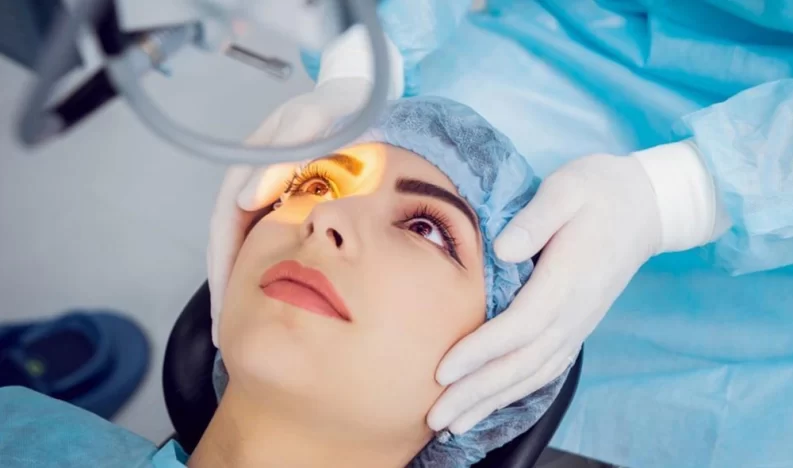
Refractive Surgery
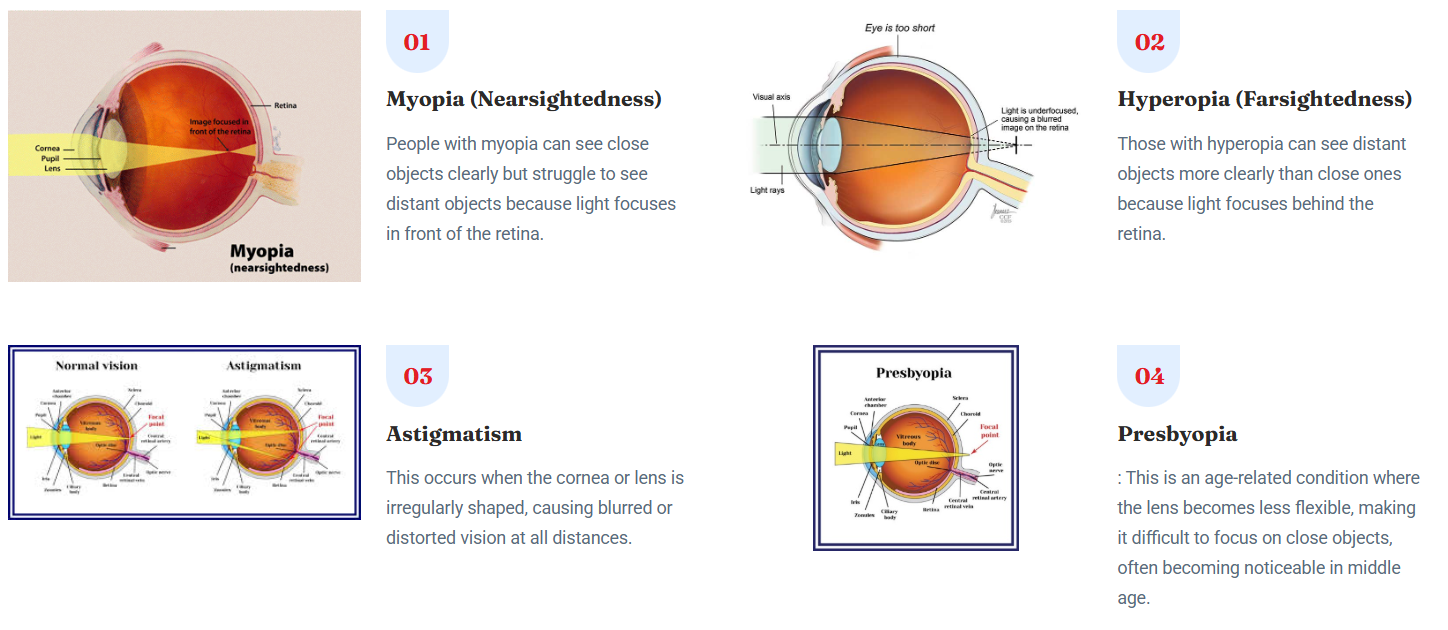
Refractive error is a common vision problem that occurs when the shape of the eye prevents light from focusing directly on the retina, which leads to blurry vision. It happens due to the eye’s inability to properly bend (refract) light rays so that they focus correctly on the retina.
Symptoms of Refractive Error
- Blurred vision: Difficulty seeing objects clearly at various distances.
- Eye strain: Discomfort or fatigue from focusing on tasks like reading or computer use.
- Headaches: Often due to the eyes working hard to focus properly.
- Difficulty seeing at night: Trouble seeing clearly in low-light conditions.
- Double vision: Seeing two images of a single object, especially with astigmatism.
- Squinting: Involuntary action to try to improve focus and clarity.
- Frequent changes in prescription: Needing new glasses or contact lenses more often.
- Difficulty with detailed tasks: Problems with activities requiring sharp vision, such as reading or sewing.
Treatments at Samarth Netralaya
1. Surface Ablation
Surface Ablation refers to a category of refractive eye surgeries where the outer layer of the cornea is directly treated with a laser to correct vision. Unlike methods that involve creating a flap in the cornea, surface ablation works on the corneal surface.
PRK (Photorefractive Keratectomy)
Under this process, an outer layer of the cornea, called the epithelium, is removed, and a laser is used to reshape the underlying corneal tissue. The epithelium then naturally regenerates over time.
Advantages:Suitable for patients with thinner corneas or other conditions that may not be ideal for flap-based procedures. Generally avoids flap-related complications.
TransPRK (Transepithelial PRK)
An advanced form of PRK where the removal of the epithelial layer and the laser reshaping of the cornea are performed in a single step. This technique uses the same laser to ablate both the epithelium and the stroma.
Advantages: More comfortable post-operatively compared to traditional PRK, with potentially faster recovery.
Samarth Netralaya Institute Support
Samarth Netralaya Institute offers tailored evaluations to determine if surface ablation is the right approach for each patient. They utilise advanced technology for precise treatment and provide comprehensive pre- and post-operative care to ensure optimal results and patient comfort throughout the healing process.
2. Ablation Under Flap
Ablation under flap refers to a group of laser eye surgeries where a flap is created in the cornea, and then the underlying corneal tissue is reshaped with a laser to correct refractive errors.
- LASIK: A flap is created in the outer layer of the cornea, and a laser reshapes the underlying corneal tissue. Advantages: Rapid visual recovery, minimal discomfort, and usually quick healing.
- Epi-LASIK:A variation where a very thin epithelial flap is created, allowing the laser treatment to be applied to the corneal stroma. Advantages: Reduces the risk of flap-related complications and is often used for patients with thinner corneas.
- Contoura LASIK: An advanced form using corneal topography to create a highly personalised treatment plan, correcting refractive errors and corneal irregularities. Advantages: Improved visual outcomes and enhanced precision.
Samarth Netralaya Institute Support
Samarth Netralaya Institute provides comprehensive care throughout the process — from initial consultations and advanced diagnostic testing to the surgery itself and follow-up care. They use cutting-edge technology and highly skilled professionals to ensure the best possible results.
3. Lenticular Extraction
is a refractive eye surgery technique where a small disc-shaped piece of corneal tissue (called a lenticule) is removed to correct vision problems such as myopia (nearsightedness) or hyperopia (farsightedness). The procedure reshapes the cornea to improve visual acuity.
Basic Concept
A small lenticule of corneal tissue is extracted through a tiny incision, often using a femtosecond laser. This technique reshapes the cornea by removing specific layers of tissue, allowing for improved vision without the need for a large corneal flap.
Advantages:Minimally invasive, often resulting in less postoperative discomfort and faster recovery compared to traditional methods involving larger incisions or flaps.
CLEAR Method (Corneal Lenticule Extraction with Anterior Segment Laser)
The CLEAR method represents an advanced approach to lenticular extraction, utilizing precise laser technology to extract the lenticule with greater accuracy and control. This technique improves visual outcomes and reduces complications by enhancing the precision of the lenticule removal process.
Advantages:Higher precision and customization of treatment, potentially better visual outcomes, reduced risk of complications, and generally faster recovery compared to traditional lenticular extraction techniques.
Samarth Netralaya Institute Support
Samarth Netralaya Institute provides cutting-edge lenticular extraction treatments, including the CLEAR method, to ensure the highest standards of care. They offer thorough pre-operative assessments to tailor the procedure to each patient’s specific needs, utilise advanced laser technology for optimal precision, and deliver comprehensive follow-up care to support a smooth recovery and excellent visual results.